
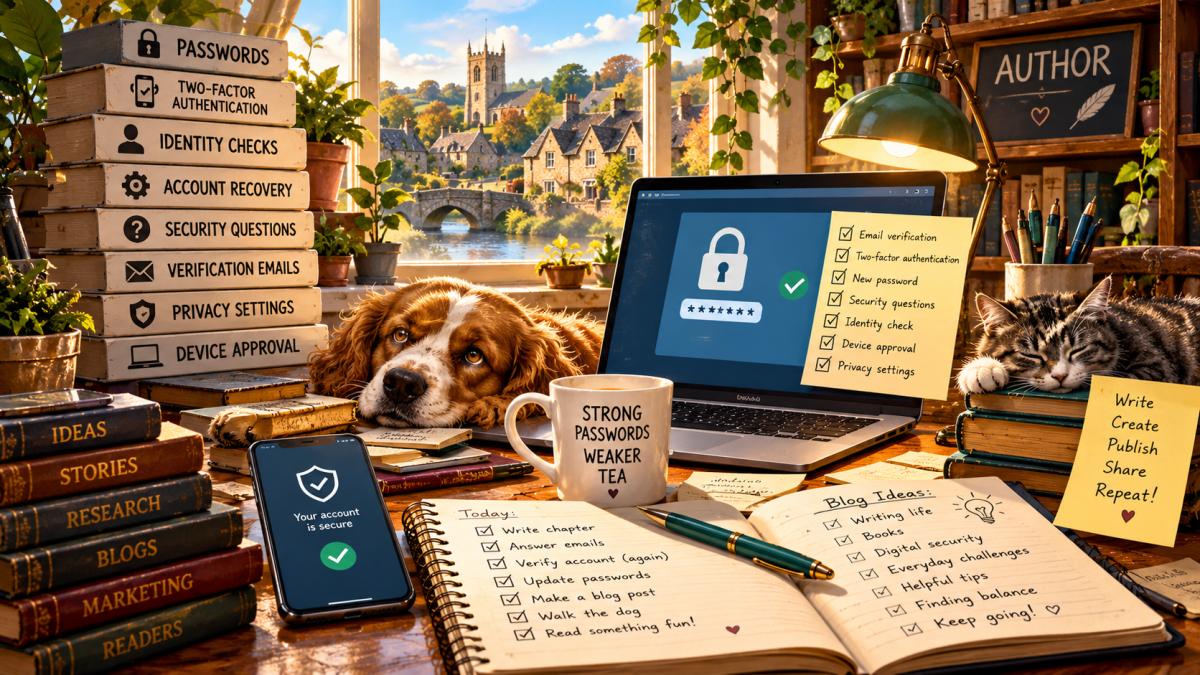
Being an Author in the Age of Digital Security
Passwords, Verification Codes, Online Accounts and the Growing Frustration of Simply Trying to Get Things Done
By Robin Wickens | Rob’s Books
There was a time when being an author was relatively straightforward.
You had an idea, found somewhere reasonably quiet, made yourself a cup of tea and began writing.
Naturally, there were interruptions. The telephone would ring, somebody would knock at the door, the dog would demand attention or an essential piece of research would disappear beneath a pile of papers.
But at least you could generally sit down and start.
Today, things are rather different.
Before I can write a chapter, publish a book, update the Rob’s Books website or investigate something interesting, I may first have to prove that I am actually me.
And not just once.
Sometimes several times, using different methods, on different devices, with different passwords, codes, verification links and increasingly elaborate security procedures.
Apparently, simply knowing who I am is no longer sufficient.
The computer would like independent confirmation.
Preferably from another computer.
And quite possibly from a mobile telephone that happens to be in another room.
Welcome to the modern world of digital security, where protecting our information is increasingly important, but accessing our own accounts can occasionally feel like applying for permission to enter a particularly suspicious government establishment.
The Modern Author: Writer, Researcher, Publisher and Reluctant Security Administrator
As the founder of Rob’s Books, I spend considerable time writing, researching, developing manuscripts and preparing digital publications.
Our books cover British history, folklore, cosy mysteries, Gothic fiction, children’s stories, cookery, puzzles and many other subjects.
Research can involve examining historical accounts, comparing sources, investigating old customs, developing fictional characters or working through the practical details of a recipe.
Then there is the publishing work.
Manuscripts need editing. Digital files need preparing. Book descriptions must be written. Covers require attention. Website categories need organising. Blog articles have to be prepared, and customers need clear information about the books we produce.
I enjoy much of this work. Indeed, I wouldn’t continue doing it if I didn’t.
What I enjoy considerably less is discovering that a perfectly ordinary publishing task has been interrupted because a website has decided that my familiar computer is suddenly an unknown device.
Perhaps I have cleared my browser cookies.
Perhaps an application has updated.
Perhaps the security system simply woke up feeling distrustful.
Whatever the reason, I am informed that unusual activity has been detected.
The unusual activity, as far as I can establish, consists of me attempting to do exactly what I did yesterday.
One Password Is Never Enough
I remember when a password was something you were expected to remember.
Now it must apparently contain a combination of uppercase letters, lowercase letters, numbers, special characters and possibly the emotional support of a small woodland animal.
Of course, strong, unique passwords are important.
Reusing the same password across numerous websites creates genuine risks. If one service suffers a data breach, criminals may attempt to use the stolen credentials elsewhere.
We should all take that seriously.
But consider the practical experience of the ordinary internet user.
You visit a website you haven’t used for several months.
You enter what you believe is your password.
Incorrect.
You try another.
Incorrect.
You request a reset.
An email arrives with a temporary link.
You open the link and enter a new password.
The website announces that your proposed password is too weak.
You strengthen it.
The website informs you that you’ve used it before.
You invent something entirely new.
Then you discover that the password cannot contain a particular symbol, despite the previous instructions appearing to encourage symbols.
Eventually, success.
You have created a password so secure that even you are unlikely to remember it.
The system congratulates you.
Five minutes later, it asks you to sign in again.
I appreciate the necessity of security.
I merely question whether the process occasionally mistakes inconvenience for effectiveness.
Two-Factor Authentication: A Sensible Idea With an Occasional Talent for Chaos
Multi-factor authentication is one of the more valuable developments in account security.
It adds an additional check beyond the password, making it more difficult for somebody else to gain access.
Passkeys, authenticator applications and hardware security keys can provide particularly strong protection when properly implemented.
The principle is sound.
The practical experience, however, can be quite another matter.
Imagine sitting at your desk, ready to upload a new book.
You enter your password.
The website wants a verification code.
You open your authenticator application.
By the time you have copied the code, it has expired.
You try again.
This time, the website requests confirmation through another device.
You reach for that device.
It needs charging.
After locating the charger, you finally authenticate successfully.
At which point the website announces that your session has expired.
Somewhere in the distance, the kettle clicks off.
And I begin to wonder whether the book might be easier to publish by carving it into a stone tablet.
The security measures are not necessarily wrong.
But they demonstrate an important point: a security system that protects an account while making legitimate access unnecessarily difficult is not providing the best possible experience.
The Accessibility Problem We Cannot Afford to Ignore
There is another aspect of modern security that deserves much more attention.
Not everyone can use the same communication methods.
I am deaf and cannot conduct verbal telephone conversations.
For me, written communication is not simply a personal preference. It is an accessibility requirement.
Email, text messages, online chat, written correspondence and other suitable text-based methods allow me to communicate effectively.
Yet some organisations still design account recovery and customer support procedures around the assumption that everybody can answer a telephone and speak to an adviser.
Imagine needing access to an important account, only to discover that the next security step requires a telephone conversation you cannot reasonably undertake.
You may have your identification documents.
You may know your account details.
You may possess your registered email address and devices.
You may be entirely capable of completing a secure written verification process.
But the organisation insists that you telephone them.
This is not merely inconvenient.
It can prevent somebody from accessing a service they are entitled to use.
And the problem extends well beyond deafness.
People with speech difficulties, hearing impairments, certain disabilities, limited mobility or communication differences may encounter similar obstacles.
Others may struggle with complex interfaces, inaccessible verification messages or systems that allow insufficient time to complete necessary steps.
Security should protect people without excluding them.
Organisations should offer accessible, equally secure alternatives for identification, verification and account recovery.
Written communication should not be treated as an inferior option or an unusual favour.
In a digital society, accessibility belongs at the beginning of system design, not as an afterthought once somebody complains.
The Great Irony of Modern Technology
Modern technology promises convenience.
We can communicate instantly, obtain information from across the world, publish books digitally, manage finances, make purchases and access services without leaving home.
These developments have brought enormous benefits.
For independent publishers such as Rob’s Books, digital technology makes it possible to distribute publications without the warehousing and stock-management requirements associated with traditional print distribution.
It also enables us to reach readers who might otherwise never discover our books.
But there is an extraordinary contradiction.
The more sophisticated our systems become, the more complicated many ordinary tasks appear to become.
We are told that a new application will simplify our work.
First, however, we must create an account.
Then verify the account.
Then configure the security settings.
Then authorise the application.
Then connect it to another application.
Then update our privacy preferences.
Then verify that we authorised the connection.
Then, approximately three days later, discover that one of the applications has changed its authentication requirements.
The technology may ultimately save time.
But I occasionally wonder whether we have remembered to include the time required to persuade it to function.
Security Fatigue: When Every Request Begins to Look the Same
One of my greatest concerns is that excessive security demands can undermine the very behaviour they are intended to encourage.
People become accustomed to approving notifications, clicking verification links and responding to messages requesting immediate action.
Eventually, another security request can become little more than an irritating interruption.
And that creates opportunities for criminals.
Fraudulent emails and messages frequently imitate legitimate security procedures.
They claim that an account has been suspended, that a password must be updated immediately or that unusual activity requires urgent confirmation.
When people are already overwhelmed by genuine security notifications, distinguishing a legitimate request from a convincing imitation can become more difficult.
This does not mean we should abandon security measures.
Quite the opposite.
It means they should be designed carefully, communicated clearly and used proportionately.
We should not have to navigate a maze of warnings, pop-ups and unexplained technical messages simply to carry out ordinary activities.
Security works best when people understand what is being asked of them and why.
Older People and the Risk of Digital Exclusion
We often hear about encouraging older people to use digital services.
Banking, healthcare appointments, shopping, public services and communication increasingly rely on websites and applications.
Many older people are perfectly capable and confident technology users.
But others find the rapid pace of change difficult.
That is not necessarily a matter of intelligence or willingness to learn.
It may simply be that systems change faster than people have an opportunity to become familiar with them.
A person who successfully learned to use one website may discover that it has been redesigned.
A familiar sign-in process may disappear.
An application may stop supporting an older device.
A security procedure may suddenly require a smartphone that the person does not own.
And when they ask for assistance, they may be directed to an online help centre that requires them to sign in to the very account they cannot access.
There is something profoundly unhelpful about that arrangement.
Digital services should make reasonable provision for people with different abilities, equipment, budgets and levels of confidence.
Nobody should be made to feel that growing older means becoming less entitled to participate in everyday life.
The Hidden Cost of Security for Small Businesses and Independent Creators
For a large organisation, digital administration may be handled by dedicated teams.
There may be specialists responsible for information security, software configuration, customer support, website maintenance and account management.
For an independent author or small publisher, many of those responsibilities fall to one person.
At Rob’s Books, the same individual who is researching a historical manuscript may also be updating the website, checking a digital download, preparing promotional descriptions and investigating why a particular account has suddenly refused access.
These tasks are all necessary.
But every hour spent resolving an avoidable technical problem is an hour that cannot be spent producing something useful for readers.
And the interruptions are not always small.
An account lockout can delay publishing.
A failed verification process can prevent access to essential services.
A compromised password can require substantial recovery work.
A poorly designed security feature can make an otherwise useful platform inaccessible.
These problems have real consequences for self-employed people, independent creators, sole traders and small businesses.
We need robust security.
But we also need security that recognises the practical realities of running a small enterprise.
The Security Industry Has a Responsibility Too
It is easy to place the entire burden of digital security upon individual users.
Choose better passwords.
Enable multi-factor authentication.
Keep your software updated.
Recognise phishing emails.
Avoid suspicious links.
Protect your devices.
Back up your files.
Use secure networks.
All sensible advice.
But individuals cannot reasonably be expected to compensate for every weakness in system design.
Technology companies, banks, retailers, publishers, public services and other organisations also have responsibilities.
They should use appropriate security measures behind the scenes, minimise unnecessary collection of personal information, communicate clearly and provide effective account recovery procedures.
Security processes should be tested with real users, including people with disabilities and those who use assistive technologies.
A complicated process is not automatically a secure process.
Nor is a simple process automatically unsafe.
Good design can make strong protection easier to use.
That should be the ambition.
Artificial Intelligence Adds Another Complication
As an author and publisher, I am particularly interested in how modern technologies can support research, writing, editing and creative production.
Artificial intelligence provides opportunities to assist with organising information, developing ideas, reviewing manuscripts and preparing publishing material.
But it also creates new questions about privacy, authenticity and information security.
AI-generated messages can be convincing.
Fraudulent communications can imitate professional correspondence.
Images, audio and other material can be manipulated.
As a result, we increasingly need to consider not only whether a message appears legitimate, but whether its apparent sender and contents can be trusted.
We should approach these developments thoughtfully rather than react with either blind enthusiasm or unnecessary panic.
New technology can provide genuine benefits.
But it must be accompanied by responsible use, good judgement and sensible safeguards.
For authors, publishers and readers alike, the ability to question information and assess its reliability is becoming increasingly valuable.
Which brings me back, rather conveniently, to the importance of reading.
Reading Carefully Is Still One of Our Best Defences
At Rob’s Books, we encourage reading for pleasure, curiosity and lifelong learning.
But reading is also a practical skill that helps people navigate the modern world.
Understanding instructions, evaluating claims, recognising inconsistencies and questioning persuasive language can all help us make better-informed decisions.
A message announcing that an account will be closed within ten minutes may be designed to create panic.
An email asking for a verification code may be attempting to bypass account protection.
An unexpected link may lead somewhere entirely different from what its wording suggests.
Careful reading and independent verification can help people recognise these risks.
Of course, literacy alone cannot eliminate online fraud.
Criminal techniques continue to develop, and even experienced technology users can be deceived.
But encouraging people to read carefully, question unexpected requests and resist artificial urgency remains valuable.
Reading is not merely a pastime.
It is part of how we understand and navigate the world around us.
What Can We Actually Do?
Rather than simply complain about passwords and verification codes, there are practical steps we can take to make our digital lives safer and less frustrating.
A reputable password manager can help create and store strong, unique passwords, reducing the need to remember dozens of complicated combinations.
Where available, passkeys can provide a convenient alternative to conventional passwords.
Multi-factor authentication should be enabled for important accounts, preferably using a secure method appropriate to the service and the user’s circumstances.
Backup codes and account recovery information should be stored securely, separately from the device they may be needed to replace.
Software and devices should be kept updated, and important files should be backed up regularly.
Unexpected security messages should be treated cautiously. Rather than following links in suspicious emails, visit the relevant service directly through its known website or application.
Never disclose a one-time verification code to somebody who unexpectedly contacts you requesting it.
And perhaps most importantly, we should all feel entitled to question security arrangements that are unnecessarily complicated or inaccessible.
Good security does not mean accepting every inconvenience without explanation.
It means understanding reasonable risks and choosing effective protections.
Security Should Make Life Safer, Not Smaller
I do not want to return to an age when personal information was casually exposed, accounts were protected by obvious passwords and criminals could access sensitive records with minimal resistance.
Modern security measures exist for good reasons.
Cybercrime is real.
Identity theft is real.
Financial fraud, account takeovers and data breaches can have serious consequences.
We should not underestimate those risks.
But neither should we accept a future in which ordinary people are increasingly excluded from essential services because they cannot navigate a constantly changing collection of verification procedures.
The balance matters.
Convenience without security can be dangerous.
Security without accessibility can be discriminatory.
And security without sensible design can become so frustrating that people begin looking for ways around it.
What we need is protection that works with people rather than against them.
A Final Thought from an Author Who Would Quite Like to Get Back to Writing
When I sit down at my desk, I generally have a fairly straightforward ambition.
I want to write something.
Perhaps a chapter about Britain’s curious traditions.
Perhaps a humorous mystery involving a village resident who knows considerably more than they admit.
Perhaps a historical account exploring the experiences of ordinary people.
Or perhaps a cookbook explaining how a handful of ingredients can become something worth sitting down to enjoy.
I would like to concentrate on research, storytelling and the pleasure of producing books.
Instead, on some days, I find myself negotiating with a security system that appears unconvinced of my existence.
I understand why precautions are necessary.
I appreciate the people working to protect our information and prevent fraud.
I simply believe we can do better.
Technology should support creativity, independence and participation.
It should help people communicate, learn, work and enjoy life.
And it should recognise that not everyone uses technology in precisely the same way.
For those of us who rely upon written communication, accessible digital services are especially important.
For older people, straightforward systems can help preserve independence.
For small businesses, reliable access can mean the difference between productive work and hours of frustration.
And for everybody, sensible security should offer peace of mind without demanding the patience of a medieval saint.
At Rob’s Books, we will continue using modern technology to create and share digital publications, support readers and develop our growing reading membership.
We will also continue encouraging people to read, question, learn and think independently.
Because in a world of rapidly changing technology, those abilities matter more than ever.
Now, if you’ll excuse me, I have a manuscript to finish.
Assuming, of course, that my computer will let me in.
Robin Wickens Founder, Author and Publisher Rob’s Books https://robs-books.uk
A Question for Our Readers
Have modern security procedures made your online life safer, more complicated or a mixture of both?
Have you ever been locked out of an account, struggled with repeated verification codes or been unable to access a service because its security process did not accommodate your needs?
I would be interested to hear your experiences, particularly from independent creators, older readers, people with disabilities and anyone who has found that technology occasionally creates more obstacles than it removes.
Join the conversation at Rob’s Books.
Being an Author in the Age of Digital Security
Passwords, Verification Codes, Online Accounts and the Growing Frustration of Simply Trying to Get Things Done
By Robin Wickens | Rob’s Books
There was a time when being an author was relatively straightforward.
You had an idea, found somewhere reasonably quiet, made yourself a cup of tea and began writing.
Naturally, there were interruptions. The telephone would ring, somebody would knock at the door, the dog would demand attention or an essential piece of research would disappear beneath a pile of papers.
But at least you could generally sit down and start.
Today, things are rather different.
Before I can write a chapter, publish a book, update the Rob’s Books website or investigate something interesting, I may first have to prove that I am actually me.
And not just once.
Sometimes several times, using different methods, on different devices, with different passwords, codes, verification links and increasingly elaborate security procedures.
Apparently, simply knowing who I am is no longer sufficient.
The computer would like independent confirmation.
Preferably from another computer.
And quite possibly from a mobile telephone that happens to be in another room.
Welcome to the modern world of digital security, where protecting our information is increasingly important, but accessing our own accounts can occasionally feel like applying for permission to enter a particularly suspicious government establishment.
The Modern Author: Writer, Researcher, Publisher and Reluctant Security Administrator
As the founder of Rob’s Books, I spend considerable time writing, researching, developing manuscripts and preparing digital publications.
Our books cover British history, folklore, cosy mysteries, Gothic fiction, children’s stories, cookery, puzzles and many other subjects.
Research can involve examining historical accounts, comparing sources, investigating old customs, developing fictional characters or working through the practical details of a recipe.
Then there is the publishing work.
Manuscripts need editing. Digital files need preparing. Book descriptions must be written. Covers require attention. Website categories need organising. Blog articles have to be prepared, and customers need clear information about the books we produce.
I enjoy much of this work. Indeed, I wouldn’t continue doing it if I didn’t.
What I enjoy considerably less is discovering that a perfectly ordinary publishing task has been interrupted because a website has decided that my familiar computer is suddenly an unknown device.
Perhaps I have cleared my browser cookies.
Perhaps an application has updated.
Perhaps the security system simply woke up feeling distrustful.
Whatever the reason, I am informed that unusual activity has been detected.
The unusual activity, as far as I can establish, consists of me attempting to do exactly what I did yesterday.
One Password Is Never Enough
I remember when a password was something you were expected to remember.
Now it must apparently contain a combination of uppercase letters, lowercase letters, numbers, special characters and possibly the emotional support of a small woodland animal.
Of course, strong, unique passwords are important.
Reusing the same password across numerous websites creates genuine risks. If one service suffers a data breach, criminals may attempt to use the stolen credentials elsewhere.
We should all take that seriously.
But consider the practical experience of the ordinary internet user.
You visit a website you haven’t used for several months.
You enter what you believe is your password.
Incorrect.
You try another.
Incorrect.
You request a reset.
An email arrives with a temporary link.
You open the link and enter a new password.
The website announces that your proposed password is too weak.
You strengthen it.
The website informs you that you’ve used it before.
You invent something entirely new.
Then you discover that the password cannot contain a particular symbol, despite the previous instructions appearing to encourage symbols.
Eventually, success.
You have created a password so secure that even you are unlikely to remember it.
The system congratulates you.
Five minutes later, it asks you to sign in again.
I appreciate the necessity of security.
I merely question whether the process occasionally mistakes inconvenience for effectiveness.
Two-Factor Authentication: A Sensible Idea With an Occasional Talent for Chaos
Multi-factor authentication is one of the more valuable developments in account security.
It adds an additional check beyond the password, making it more difficult for somebody else to gain access.
Passkeys, authenticator applications and hardware security keys can provide particularly strong protection when properly implemented.
The principle is sound.
The practical experience, however, can be quite another matter.
Imagine sitting at your desk, ready to upload a new book.
You enter your password.
The website wants a verification code.
You open your authenticator application.
By the time you have copied the code, it has expired.
You try again.
This time, the website requests confirmation through another device.
You reach for that device.
It needs charging.
After locating the charger, you finally authenticate successfully.
At which point the website announces that your session has expired.
Somewhere in the distance, the kettle clicks off.
And I begin to wonder whether the book might be easier to publish by carving it into a stone tablet.
The security measures are not necessarily wrong.
But they demonstrate an important point: a security system that protects an account while making legitimate access unnecessarily difficult is not providing the best possible experience.
The Accessibility Problem We Cannot Afford to Ignore
There is another aspect of modern security that deserves much more attention.
Not everyone can use the same communication methods.
I am deaf and cannot conduct verbal telephone conversations.
For me, written communication is not simply a personal preference. It is an accessibility requirement.
Email, text messages, online chat, written correspondence and other suitable text-based methods allow me to communicate effectively.
Yet some organisations still design account recovery and customer support procedures around the assumption that everybody can answer a telephone and speak to an adviser.
Imagine needing access to an important account, only to discover that the next security step requires a telephone conversation you cannot reasonably undertake.
You may have your identification documents.
You may know your account details.
You may possess your registered email address and devices.
You may be entirely capable of completing a secure written verification process.
But the organisation insists that you telephone them.
This is not merely inconvenient.
It can prevent somebody from accessing a service they are entitled to use.
And the problem extends well beyond deafness.
People with speech difficulties, hearing impairments, certain disabilities, limited mobility or communication differences may encounter similar obstacles.
Others may struggle with complex interfaces, inaccessible verification messages or systems that allow insufficient time to complete necessary steps.
Security should protect people without excluding them.
Organisations should offer accessible, equally secure alternatives for identification, verification and account recovery.
Written communication should not be treated as an inferior option or an unusual favour.
In a digital society, accessibility belongs at the beginning of system design, not as an afterthought once somebody complains.
The Great Irony of Modern Technology
Modern technology promises convenience.
We can communicate instantly, obtain information from across the world, publish books digitally, manage finances, make purchases and access services without leaving home.
These developments have brought enormous benefits.
For independent publishers such as Rob’s Books, digital technology makes it possible to distribute publications without the warehousing and stock-management requirements associated with traditional print distribution.
It also enables us to reach readers who might otherwise never discover our books.
But there is an extraordinary contradiction.
The more sophisticated our systems become, the more complicated many ordinary tasks appear to become.
We are told that a new application will simplify our work.
First, however, we must create an account.
Then verify the account.
Then configure the security settings.
Then authorise the application.
Then connect it to another application.
Then update our privacy preferences.
Then verify that we authorised the connection.
Then, approximately three days later, discover that one of the applications has changed its authentication requirements.
The technology may ultimately save time.
But I occasionally wonder whether we have remembered to include the time required to persuade it to function.
Security Fatigue: When Every Request Begins to Look the Same
One of my greatest concerns is that excessive security demands can undermine the very behaviour they are intended to encourage.
People become accustomed to approving notifications, clicking verification links and responding to messages requesting immediate action.
Eventually, another security request can become little more than an irritating interruption.
And that creates opportunities for criminals.
Fraudulent emails and messages frequently imitate legitimate security procedures.
They claim that an account has been suspended, that a password must be updated immediately or that unusual activity requires urgent confirmation.
When people are already overwhelmed by genuine security notifications, distinguishing a legitimate request from a convincing imitation can become more difficult.
This does not mean we should abandon security measures.
Quite the opposite.
It means they should be designed carefully, communicated clearly and used proportionately.
We should not have to navigate a maze of warnings, pop-ups and unexplained technical messages simply to carry out ordinary activities.
Security works best when people understand what is being asked of them and why.
Older People and the Risk of Digital Exclusion
We often hear about encouraging older people to use digital services.
Banking, healthcare appointments, shopping, public services and communication increasingly rely on websites and applications.
Many older people are perfectly capable and confident technology users.
But others find the rapid pace of change difficult.
That is not necessarily a matter of intelligence or willingness to learn.
It may simply be that systems change faster than people have an opportunity to become familiar with them.
A person who successfully learned to use one website may discover that it has been redesigned.
A familiar sign-in process may disappear.
An application may stop supporting an older device.
A security procedure may suddenly require a smartphone that the person does not own.
And when they ask for assistance, they may be directed to an online help centre that requires them to sign in to the very account they cannot access.
There is something profoundly unhelpful about that arrangement.
Digital services should make reasonable provision for people with different abilities, equipment, budgets and levels of confidence.
Nobody should be made to feel that growing older means becoming less entitled to participate in everyday life.
The Hidden Cost of Security for Small Businesses and Independent Creators
For a large organisation, digital administration may be handled by dedicated teams.
There may be specialists responsible for information security, software configuration, customer support, website maintenance and account management.
For an independent author or small publisher, many of those responsibilities fall to one person.
At Rob’s Books, the same individual who is researching a historical manuscript may also be updating the website, checking a digital download, preparing promotional descriptions and investigating why a particular account has suddenly refused access.
These tasks are all necessary.
But every hour spent resolving an avoidable technical problem is an hour that cannot be spent producing something useful for readers.
And the interruptions are not always small.
An account lockout can delay publishing.
A failed verification process can prevent access to essential services.
A compromised password can require substantial recovery work.
A poorly designed security feature can make an otherwise useful platform inaccessible.
These problems have real consequences for self-employed people, independent creators, sole traders and small businesses.
We need robust security.
But we also need security that recognises the practical realities of running a small enterprise.
The Security Industry Has a Responsibility Too
It is easy to place the entire burden of digital security upon individual users.
Choose better passwords.
Enable multi-factor authentication.
Keep your software updated.
Recognise phishing emails.
Avoid suspicious links.
Protect your devices.
Back up your files.
Use secure networks.
All sensible advice.
But individuals cannot reasonably be expected to compensate for every weakness in system design.
Technology companies, banks, retailers, publishers, public services and other organisations also have responsibilities.
They should use appropriate security measures behind the scenes, minimise unnecessary collection of personal information, communicate clearly and provide effective account recovery procedures.
Security processes should be tested with real users, including people with disabilities and those who use assistive technologies.
A complicated process is not automatically a secure process.
Nor is a simple process automatically unsafe.
Good design can make strong protection easier to use.
That should be the ambition.
Artificial Intelligence Adds Another Complication
As an author and publisher, I am particularly interested in how modern technologies can support research, writing, editing and creative production.
Artificial intelligence provides opportunities to assist with organising information, developing ideas, reviewing manuscripts and preparing publishing material.
But it also creates new questions about privacy, authenticity and information security.
AI-generated messages can be convincing.
Fraudulent communications can imitate professional correspondence.
Images, audio and other material can be manipulated.
As a result, we increasingly need to consider not only whether a message appears legitimate, but whether its apparent sender and contents can be trusted.
We should approach these developments thoughtfully rather than react with either blind enthusiasm or unnecessary panic.
New technology can provide genuine benefits.
But it must be accompanied by responsible use, good judgement and sensible safeguards.
For authors, publishers and readers alike, the ability to question information and assess its reliability is becoming increasingly valuable.
Which brings me back, rather conveniently, to the importance of reading.
Reading Carefully Is Still One of Our Best Defences
At Rob’s Books, we encourage reading for pleasure, curiosity and lifelong learning.
But reading is also a practical skill that helps people navigate the modern world.
Understanding instructions, evaluating claims, recognising inconsistencies and questioning persuasive language can all help us make better-informed decisions.
A message announcing that an account will be closed within ten minutes may be designed to create panic.
An email asking for a verification code may be attempting to bypass account protection.
An unexpected link may lead somewhere entirely different from what its wording suggests.
Careful reading and independent verification can help people recognise these risks.
Of course, literacy alone cannot eliminate online fraud.
Criminal techniques continue to develop, and even experienced technology users can be deceived.
But encouraging people to read carefully, question unexpected requests and resist artificial urgency remains valuable.
Reading is not merely a pastime.
It is part of how we understand and navigate the world around us.
What Can We Actually Do?
Rather than simply complain about passwords and verification codes, there are practical steps we can take to make our digital lives safer and less frustrating.
A reputable password manager can help create and store strong, unique passwords, reducing the need to remember dozens of complicated combinations.
Where available, passkeys can provide a convenient alternative to conventional passwords.
Multi-factor authentication should be enabled for important accounts, preferably using a secure method appropriate to the service and the user’s circumstances.
Backup codes and account recovery information should be stored securely, separately from the device they may be needed to replace.
Software and devices should be kept updated, and important files should be backed up regularly.
Unexpected security messages should be treated cautiously. Rather than following links in suspicious emails, visit the relevant service directly through its known website or application.
Never disclose a one-time verification code to somebody who unexpectedly contacts you requesting it.
And perhaps most importantly, we should all feel entitled to question security arrangements that are unnecessarily complicated or inaccessible.
Good security does not mean accepting every inconvenience without explanation.
It means understanding reasonable risks and choosing effective protections.
Security Should Make Life Safer, Not Smaller
I do not want to return to an age when personal information was casually exposed, accounts were protected by obvious passwords and criminals could access sensitive records with minimal resistance.
Modern security measures exist for good reasons.
Cybercrime is real.
Identity theft is real.
Financial fraud, account takeovers and data breaches can have serious consequences.
We should not underestimate those risks.
But neither should we accept a future in which ordinary people are increasingly excluded from essential services because they cannot navigate a constantly changing collection of verification procedures.
The balance matters.
Convenience without security can be dangerous.
Security without accessibility can be discriminatory.
And security without sensible design can become so frustrating that people begin looking for ways around it.
What we need is protection that works with people rather than against them.
A Final Thought from an Author Who Would Quite Like to Get Back to Writing
When I sit down at my desk, I generally have a fairly straightforward ambition.
I want to write something.
Perhaps a chapter about Britain’s curious traditions.
Perhaps a humorous mystery involving a village resident who knows considerably more than they admit.
Perhaps a historical account exploring the experiences of ordinary people.
Or perhaps a cookbook explaining how a handful of ingredients can become something worth sitting down to enjoy.
I would like to concentrate on research, storytelling and the pleasure of producing books.
Instead, on some days, I find myself negotiating with a security system that appears unconvinced of my existence.
I understand why precautions are necessary.
I appreciate the people working to protect our information and prevent fraud.
I simply believe we can do better.
Technology should support creativity, independence and participation.
It should help people communicate, learn, work and enjoy life.
And it should recognise that not everyone uses technology in precisely the same way.
For those of us who rely upon written communication, accessible digital services are especially important.
For older people, straightforward systems can help preserve independence.
For small businesses, reliable access can mean the difference between productive work and hours of frustration.
And for everybody, sensible security should offer peace of mind without demanding the patience of a medieval saint.
At Rob’s Books, we will continue using modern technology to create and share digital publications, support readers and develop our growing reading membership.
We will also continue encouraging people to read, question, learn and think independently.
Because in a world of rapidly changing technology, those abilities matter more than ever.
Now, if you’ll excuse me, I have a manuscript to finish.
Assuming, of course, that my computer will let me in.
Robin Wickens Founder, Author and Publisher Rob’s Books https://robs-books.uk
A Question for Our Readers
Have modern security procedures made your online life safer, more complicated or a mixture of both?
Have you ever been locked out of an account, struggled with repeated verification codes or been unable to access a service because its security process did not accommodate your needs?
I would be interested to hear your experiences, particularly from independent creators, older readers, people with disabilities and anyone who has found that technology occasionally creates more obstacles than it removes.
Join the conversation at Rob’s Books.